
C++中的类: 操作符重载
操作符重载
函数重载与操作符重载对比
函数重载(静态多态):同名,形参不同,由编译器在编译期根据参数列表选择具体函数版本,实现“一名多用”的静态多态(与继承+虚函数的“动态多态”不同)。
操作符重载:
允许程序员:
- 内建类型之间已有的运算符(+ - * / >>等)
- 自定义类型,重新定义运算含义(但语法/优先级/结合性保持不变)
作用如下:
- 提高可读性:
c = a + b比c = a.add(b)更直观 - 提高可扩展性:让自定义类型“像内建类型一样用”
例子(思路对比):
1 | class Complex { |
注意两点:
operator+的参数中至少有一个是用户自定义类型(否则会和内建运算冲突;new/delete例外)。- 写成运算符形式:易理解、优先级/结合性自然正确(复用语言已有规则)。
操作符重载基本原则与常见的操作符重载
- 可重载的运算符列表:像
.,::,?:,sizeof这类不能重载;其他大部分算术、关系、位运算、[],->,++,--都可以。 - 方式:
- 成员函数
- 带有“类的类型参数”的全局函数(包括友元)
- 必须遵循原有语法规则:
- 单目/双目的“目数”不能变
- 运算符的优先级、结合性不能变
双目操作符重载
成员函数写法:
1
2
3
4
5
6
7
class T {
public:
ret_type operator#(const T& rhs); // 双目:lhs # rhs
};
T a, b;
a对于双目运算符(如+, -, *, ==等),若写成成员函数,左操作数是隐含的
this,右操作数是显式参数。全局函数写法:
1
2
3
4
5
// 友元声明在类里
friend ret_type operator#(arg1, arg2);
// 在命名空间/全局实现
ret_type operator#(arg1, arg2);限制:
=,(),[]不能作为全局函数进行重载,只能是成员。因为这些运算符需要直接访问/改变对象内部状态,语言规定必须由类自己提供。为什么还需要全局函数版的
operator+?1
2
3
4
5
6
7
8
9class CL {
int count;
public:
friend CL operator+(int i, CL& a); // 支持 10 + obj
friend CL operator+(CL& a, int i); // 支持 obj + 10
};
obj + 10 // 可以用成员函数:obj.operator+(10)
10 + obj // 左边不是类对象,成员函数没法支持说明:
- 成员函数重载
operator+时,左操作数必须是该类对象; - 如果希望
10 + obj这种写法,就必须用非成员(通常是友元)函数来重载。
- 成员函数重载
不要重载
&&和||:1
2
3
4
5
6
7
8
9char* p;
if ((p != 0) && (strlen(p) > 10)) ...
// 如果你重载了 &&
if (expression1 && expression2) ...
// 其实会被视作
if (expression1.operator&&(expression2)) ...
// 或
if (operator&&(expression1, expression2)) ...说明:
- 内建的
&&/||有短路求值:左边为假时右边根本不求值; - 一旦你自定义
operator&&/operator||,就会变成普通函数调用,无法实现同样的短路语义,代码含义会非常诡异。 - 不能重载
?:的原因和这个是类似的。
- 内建的
操作符重载的设计
在追求效率时,不能返回引用而破坏语义/安全。
1 | class Rational { |
单目操作符重载
成员函数写法:
1
2
3
4class T {
public:
ret_type operator#(); // 隐含 this,当作一元运算:obj # 或 #obj
};全局函数写法:
1
ret_type operator#(T arg); // 把对象当作显式参数
a++vs++a的重载1
2
3
4
5
6
7
8
9
10
11
12
13
14
15
16
17
18class Counter {
int value;
public:
Counter() { value = 0; }
// 前缀 ++a
Counter& operator++() {
value++;
return *this; // 返回引用:++a 是左值
}
// 后缀 a++(靠一个 dummy int 区分)
Counter operator++(int) {
Counter temp = *this; // 先保存旧值
value++;
return temp; // 返回旧值:a++ 是右值
}
};要点:
- 前缀:
Counter& operator++(),返回引用,效率高,可作左值; - 后缀:
Counter operator++(int),参数里的int只是“占位用来区分语法”,返回值通常是按值拷贝(旧值)。
- 前缀:
特殊操作符重载
=
如果类里没有自己写
operator()=,编译器会自动生成一个“默认赋值运算符”:逐个成员赋值;含有对象成员的类递归进行赋值。赋值操作符重载不能继承:子类和基类的成员不完全一致,基类自己写的
operator()=不会自动传给子类;子类要么自己再显示定义一个要么接受编译器自动生成的。返回值:一般写成
T& operator()=(const T& rhs);,这样可以支持链式赋值:a = b = c;,先算b = c,得到b的引用再赋给a。有指针成员时的赋值:
1
2
3
4
5
6
7
8
9
10
11
12
13
14
15
16
17
18
19
20
21
22
23
24
25
26
27
28
29class A {
int x, y;
char* p;
public:
A(int i, int j, const char* s) : x(i), y(j) {
p = new char[strlen(s) + 1];
strcpy(p, s);
}
virtual ~A() { delete[] p; }
// 错误写法:自赋值的时候一定炸
A& operator=(A& a) {
x = a.x; y = a.y;
delete []p; // 不要先进行删除
p = new char[strlen(a.p) + 1]; // 如果new失败了会出现悬空指针的隐患
strcpy(p, a.p);
return *this;
}
// 正确写法
A& operator=(const A& a) {
char* pOrig = p; // 记住旧指针
p = new char[strlen(a.p) + 1]; // 先分配新空间
strcpy(p, a.p); // 拷贝内容
delete[] pOrig; // 再释放旧空间
x = a.x; y = a.y;
return *this;
}
};避免自赋值:
赋值运算符里要考虑自赋值的情况:1
2
3
4
5
6
7
8Widget& Widget::operator=(const Widget& rhs) {
if (this == &rhs) // identity test:左右指向同一个对象
return *this; // 什么都不做,直接返回
delete pb;
pb = new Bitmap(*rhs.pb);
return *this;
}this == &rhs为真,说明是s = s;这种自赋值,直接返回最安全,也省事。如果不做检查:先delete pb;把自己数据删了然后再从rhs.pb(已经被删了)中拷贝,行为未定义会抛出异常。或者是改成下面的写法也可以直接避免自赋值:
1
2
3
4
5
6Widget& Widget::operator=(const Widget& rhs) {
Bitmap* pOrig = pb;
pb = new Bitmap(*rhs.pb); // 不管是不是自赋值都拿新地址
delete pOrig;
return *this;
}
[]
读写vs只读:
1
2
3
4
5
6
7
8
9
10
11
12
13
14
15
16
17
18
19
20
21
22
23
24class string {
char* p;
public:
string(const char* p1) {
p = new char[strlen(p1)+1];
strcpy(p, p1);
}
char& operator[](int i) { // 非 const 对象
return p[i]; // 返回 char&,可修改
}
const char operator[](int i) const { // const 对象
return p[i]; // 返回值,只读
}
virtual ~string() { delete[] p; }
};
string s("aacd");
s[2] = 'b'; // OK,可写
const string cs("const");
cout << cs[0]; // 读 OK
cs[0] = 'D'; // 编译错误:const 对象只能调用 const 版本,只读给
operator[]通常提供两套重载:- 非
const版本:返回非常量引用,支持写操作 const版本:加上尾部const,对const对象调用,只允许读操作
- 非
多维数组:
希望通过operator[]来实现data[i][j]。底层实现:
- Array2D其实只持有一个
int *p,指向n1 * n2个int的一维数组 - 用公式
i * n2 + j把二维下标变成一维下标
1
2
3
4
5
6
7
8
9
10
11
12
13
14
15
16
17
18
19
20
21
22
23
24
25
26
27
28class Array2D {
public:
class Array1D {
public:
Array1D(int* p) : p(p) {}
int& operator[](int index) { return p[index]; }
const int operator[](int index) const { return p[index]; }
private:
int* p;
};
Array2D(int n1, int n2) {
p = new int[n1*n2];
num1 = n1; num2 = n2;
}
~Array2D() { delete[] p; }
Array1D operator[](int index) { // data[i]
return Array1D(p + index * num2); // 指向第 i 行起点
}
const Array1D operator[](int index) const {
return Array1D(p + index * num2);
}
private:
int* p;
int num1, num2;
};调用链如下:
- data[i]->
Array2D::operator[],返回一个Array1D对象(第i行) - data[i][j]->
data[i].operator[](j),调用的是Array1D::operator[],返回data[i][j]值的引用
- Array2D其实只持有一个
()
函数对象:给类重载
operator()以后,这个类的对象就可以像函数一样调用:1
2
3
4
5
6
7
8
9
10
11
12
13
14
15
16class Array2D {
int n1, n2;
int* p;
public:
Array2D(int l, int c) : n1(l), n2(c) {
p = new int[n1 * n2];
}
virtual ~Array2D() { delete[] p; }
int& operator()(int i, int j) {
return p[i * n2 + j];
}
};
Array2D a(2, 3);
a(1, 2) = 0;作为比较器:以
sort为例1
2
3
4
5
6
7
8
9
10
11
12
13
14
15bool cmpInt(int a, int b) { return a < b; } // 普通函数
class CmpInt {
public:
bool operator()(int a, int b) const { // 函数对象
return a < b;
}
};
int main() {
std::vector<int> items { 4, 3, 1, 2 };
std::sort(items.begin(), items.end(), cmpInt); // 函数指针
std::sort(items.begin(), items.end(), CmpInt()); // 函数对象
std::sort(items.begin(), items.end(), [](int a, int b) { return a < b; }); // lambda
}std::sort的第三个参数是Compare comp,只要写comp(x,y)能编译就行;- 能这样调用的东西叫“可调用对象”:
- 普通函数(传函数指针);
- 重载了
operator()的对象(functor / 函数对象); - lambda:编译器自动生成一个匿名类,内部也是
operator()。
这就是为什么operator()被称为“函数调用运算符”:重载它,可以让你的对象“像函数一样被调用”
函数对象
函数指针:
- 只能指向一个普通函数
- 自己不能带状态(例如系数、阈值)
- 编译器对它做内联优化比较受限
函数对象(重载operator()的类):
- 是对象,可以有成员变量(能带状态)
- 是类,编译器可以内联调用,性能往往更好
例子:
1 | class Multiply { |
Lambda函数
lambda只是创建函数对象的一种语法糖,编译器会自动生成一个匿名函数对象类。
例子:
1 | auto add5 = [base = 5](int x) { return x + base; }; |
用数学里的λ演算对比C++的lambda: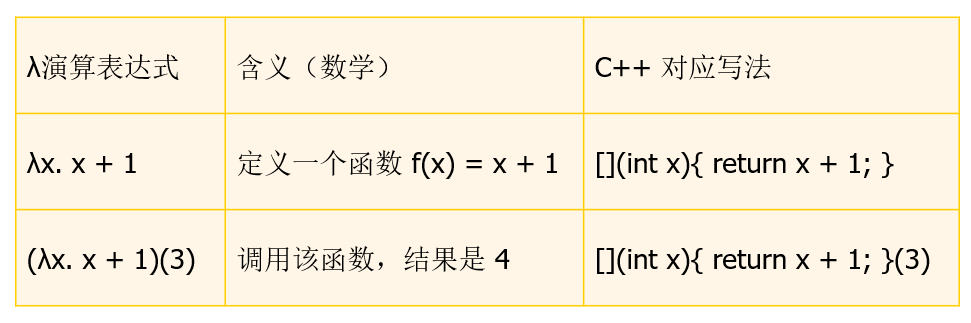
捕获列表[]不同写法的含义:
| 捕获列表写法 | 含义 |
|---|---|
[] |
不捕获任何外部变量 |
[&] |
以引用方式捕获所有在当前作用域中被用到的外部变量 |
[=] |
以值拷贝方式捕获所有在当前作用域中被用到的外部变量 |
[=, &foo] |
默认按值捕获需要的变量,但 foo 这个变量以引用方式捕获 |
[bar] |
仅按值捕获 bar,不捕获任何其他变量 |
Lambda使用例子(过滤器):
1 | vector<string> str_filter(vector<string>& vec, |



去听サイエンス谢谢喵ヾ(=`ω´=)ノ”